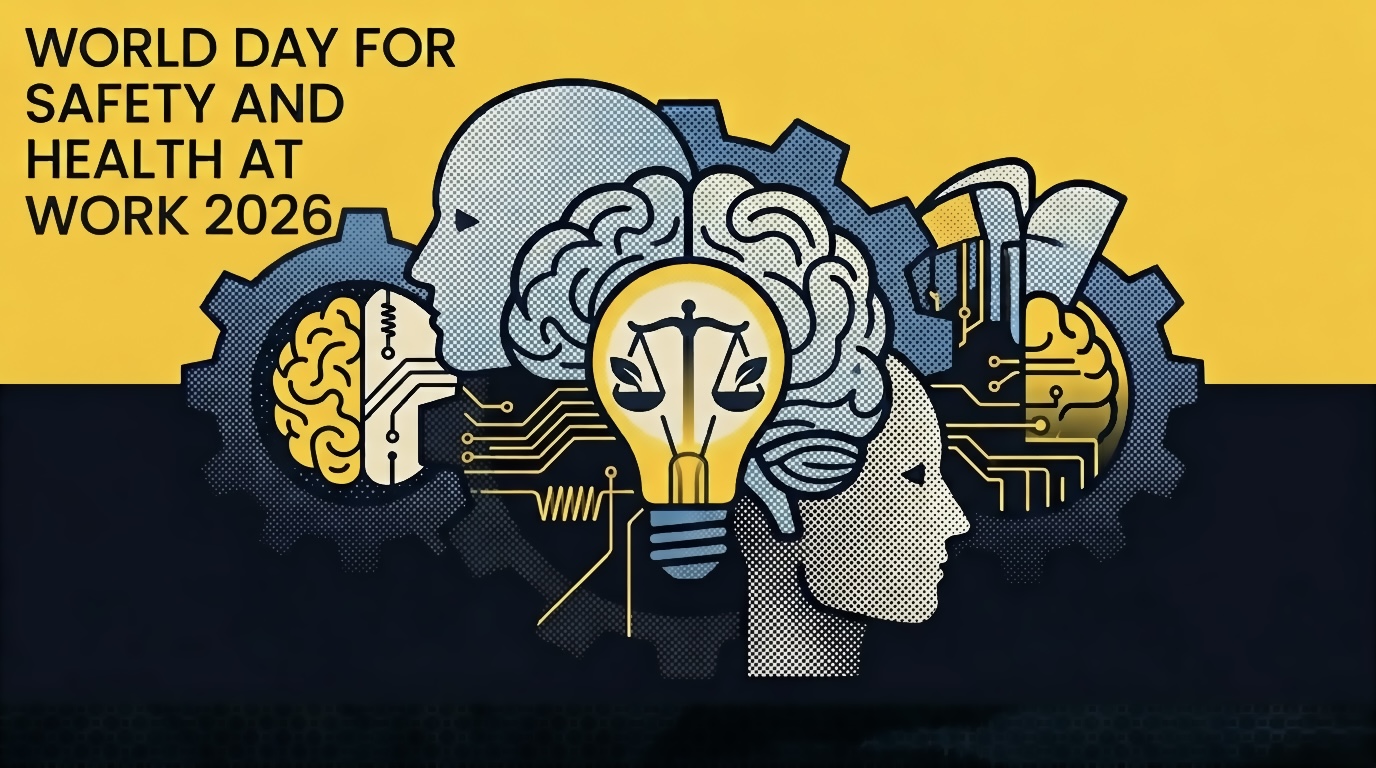
On April 28, the World Day for Safety and Health at Work returns with a message that feels increasingly relevant in today’s workplaces: safety is not only about preventing accidents —it’s about understanding the conditions in which people are expected to perform.
Observed globally and led by the International Labour Organization (ILO), the day has long been associated with reducing injuries and occupational diseases. But in 2026, the focus moves in a more nuanced direction, placing attention on what is known as the psychosocial working environment — a term that, while technical, points to something deeply familiar.
It speaks to the everyday reality of work: how tasks are structured, how time is managed, how clearly roles are defined, and how much support people actually receive. It also captures something less tangible but equally decisive — how work is experienced internally. For years, workplace safety has been framed around visible risks. Helmets, protocols, warning signs. The kind of measures designed to prevent immediate, physical harm. But the nature of risk has evolved, and so has the way it manifests.
Today, a significant portion of workplace incidents cannot be traced back to a single hazard or system failure. Instead, they emerge in moments that feel ordinary: when someone is rushing to meet a deadline, working through fatigue, navigating unclear instructions, or trying to compensate for a lack of support. These are not isolated situations — they are structural conditions that shape attention, judgment, and behavior. When these pressures accumulate, they stop being part of the job and start becoming a risk factor.
This is precisely where the idea of a healthy psychosocial working environment becomes critical. It reframes safety not as a checklist, but as a system of conditions. When workloadsare realistic, expectations are clear, communication flows, and people retain a sense of control over their work, performance tends to stabilize. Not because individuals are trying harder, but because the environment allows them to.
The opposite is also true. Environments marked by constant urgency, ambiguity, or limited support don’t just affect morale. They quietly increase the likelihood of errors.
At the same time, the context of work itself is shifting. The integration of AI, automation, and digital tools has redefined both the pace and structure of many roles. In some cases, these technologies reduce exposure to physical risk by taking over repetitive or hazardous tasks. In others, they introduce new forms of strain: longer screen time, blurred boundaries between work and rest, intensified workloads, and reduced autonomy in decision-making.
The result is a more complex safety landscape, where physical and psychological factors are no longer separate conversations, but part of the same system.
That complexity is part of why April 28 continues to matter. Not as a symbolic reminder, but as a moment to reassess how safety is being understood and applied in practice. For many organizations, it becomes an opportunity to step back and ask a more precise question: are we only preventing visible risks, or are we also addressing the conditions that shape how people work every day?
Because ultimately, safety is not defined by the absence of incidents. It is defined by the presence of conditions that make consistent, focused, and sustainable work possible.
And those conditions are built — or overlooked — long before anything goes wrong.